

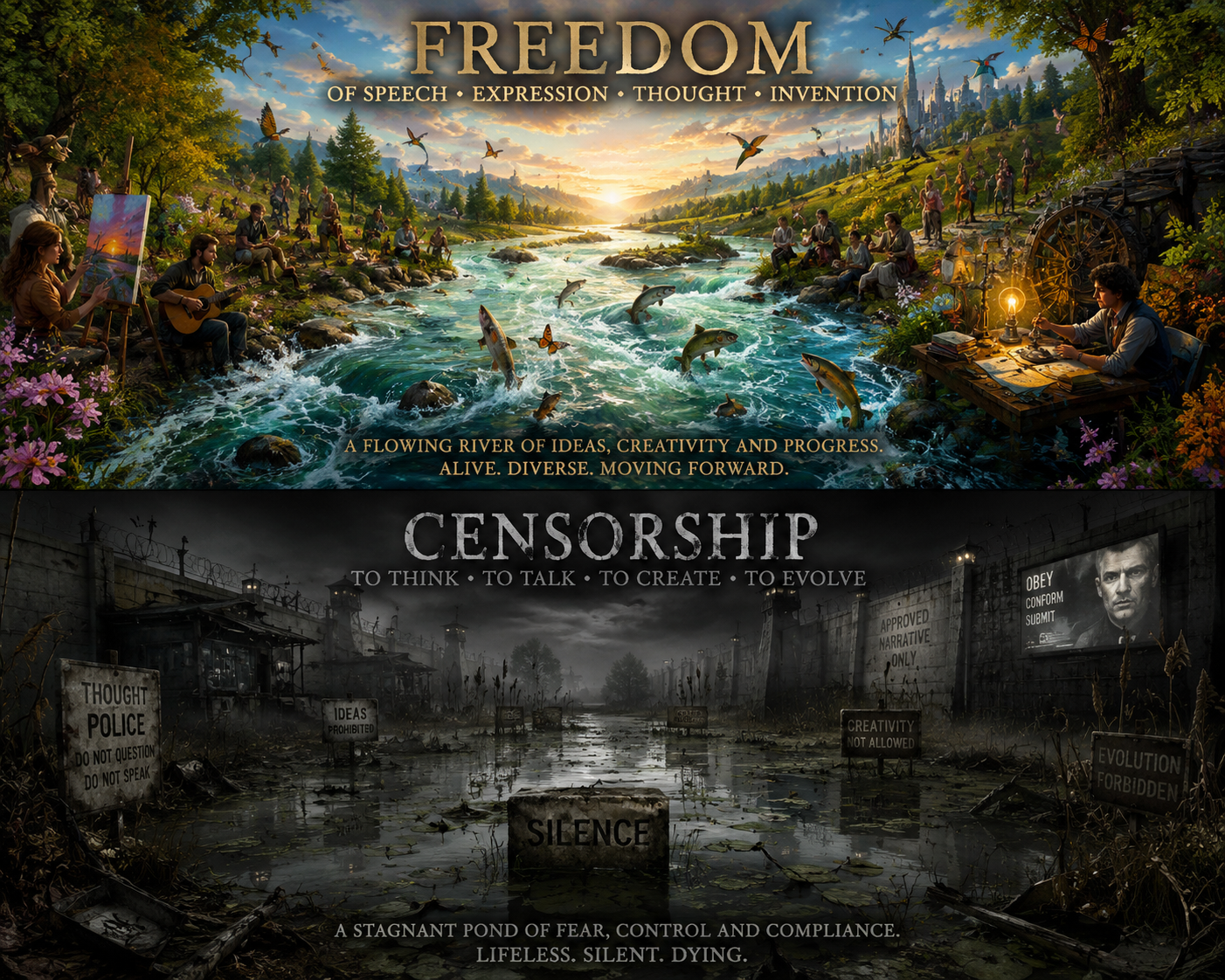


England’s constitutional rights to thought, speech, and expression are not abstract ideals — they are the operating system of our civilisation, that has driven every invention, discovery, and breakthrough our people have ever produced. The freedom to think without permission, to speak without fear, and to express ideas openly is what evolves into the freedom to invent, solve problems, and push civilisation forward. These liberties built the printing press revolution, the industrial age, modern science, engineering, and every creative leap that shaped England into a nation of innovators.
England’s constitutional rights to thought, speech, and expression are not modern inventions. They are ancient, inherited, and repeatedly affirmed across nearly 1100 years of constitutional development. These rights are not optional. They are not decorative. They are not granted by government. They are pre‑existing liberties that government is required to respect.
To restrict these rights — whether through digital regulation, compelled monitoring, or limits on lawful expression — is to restrict the very mechanism by which we evolve. Halt free thought and free speech, and you halt invention. Halt invention, and you halt national progress.

For centuries, English liberty has rested on a simple but powerful chain:
-
Freedom of Thought — the right to form ideas without interference
-
Freedom of Speech — the right to articulate those ideas
-
Freedom of Expression — the right to develop, refine, publish, and debate them
-
Freedom to Invent — the natural outcome of minds allowed to explore without fear
This chain is visible throughout our history. From the scientific revolution to the industrial age, from engineering to literature, from medicine to modern computing — English innovation has always depended on the absence of state‑mandated thought control.
These rights are not optional cultural ornaments. They are functional liberties that generate national progress.
How Free Speech Creates Innovation
Innovation is not magic. It is a predictable result of a society that protects:
-
open debate
-
dissent
-
criticism
-
unconventional ideas
-
minority viewpoints
-
uncomfortable truths
When people can think freely and speak freely, they can invent freely. The English common law created patents, so that inventors would be rewarded and in turn, that created the free market economy. In effect it is inventions that solve problems and society evolves.
Every engine, every bridge, every scientific discovery, every medical advancement, every artistic movement — all of it originates from the constitutional right to think and speak without fear.
Remove those rights, and you remove the conditions required for invention.
Freedom of speech is the foundation of England’s constitutional tradition — from Magna Carta (1215) to the Bill of Rights (1689). Modern democratic society depends on the ability to speak, debate, criticise, and challenge authority without fear of censorship or criminalisation.
Magna Carta (1215): Freedom from Arbitrary Power
Magna Carta established the principle that the Crown cannot act arbitrarily. This is the foundation of intellectual liberty, because a government that cannot arbitrarily punish its people cannot arbitrarily punish their ideas.
It created the first constitutional barrier against:
-
forced conformity
-
compelled belief
-
arbitrary censorship
This is the soil from which freedom of thought grows.

Magna Carta did not merely restrain the Crown — it established the principle that power cannot interfere with the mind of the free Englishman. By prohibiting arbitrary punishment, it created the first constitutional shield protecting:
-
independent thought
-
dissent
-
intellectual autonomy
A government that cannot arbitrarily punish you cannot arbitrarily punish your ideas. This is the constitutional birth of freedom of thought.
The Common Law Principle of “Freeborn Englishmen”
For centuries, judges recognised that English subjects possessed inherent liberties simply by virtue of being freeborn. These included:
 These were not permissions. They were rights that existed before Parliament.
This doctrine is the backbone of English constitutional identity: The English mind is free unless explicitly and lawfully restricted — and lawful restriction must be exceptional, not routine.
The Bill of Rights (1689): Limiting State Power Over Speech
The Bill of Rights prohibits the Crown from:
-
suspending laws
-
creating new offences
-
punishing political criticism
-
interfering with parliamentary speech
While focused on political liberty, it establishes the constitutional rule that speech cannot be criminalised merely because it displeases authority.
This principle naturally extends to:

The right to criticise is the right to innovate.
This is not just political protection — it is constitutional recognition that speech is a core liberty, not a tool of government.
If authority cannot punish political speech, it cannot legitimately punish lawful expression, scientific debate, artistic creation, or inventive thought.
The Bill of Rights is the constitutional firewall against censorship.
The Act of Settlement 1701
Within the English constitutional tradition, inherent rights arise not from transient legislation but from the ancient common law, the Coronation Oath, and the historic settlements that bind the Crown and state alike. Central among these is Article 9 of the Bill of Rights, which secures freedom of speech and free debate as a constitutional limitation on power, ensuring that no authority may impeach or question lawful expression in Parliament.
Crucially, this protection does not stand alone: the Act of Settlement 1701 declares that all and singular the rights and liberties confirmed by the Bill of Rights are to stand “for ever”, whether taken individually or collectively, giving permanent force to each right in isolation and to the constitutional settlement as a whole. In this structure, freedom of speech is not a modern civil liberty granted by statute, nor a regulatory category subject to administrative revision, but an inherent English right — a constitutional safeguard necessary for petitioning the Crown, exposing unlawful governance, maintaining jury independence, and preserving the free Protestant polity. It is therefore part of the enduring fabric of English law, binding upon the modern state just as firmly as upon the state of 1689, and incapable of lawful repeal without overthrowing the settlement itself.

The Common Law Protection of Expression and Publication

Long before modern statutes, English courts defended:
pamphleteers, inventors, scientists, political writers, engineers, publishers
The principle was simple: expression is lawful unless explicitly prohibited.
This presumption of liberty is what allowed:
-
the scientific revolution
-
the industrial revolution
-
the engineering revolution
-
the modern computing revolution
All of these required the ability to express new ideas without fear. England invented so much because England protected expression so fiercely.
Freedom of Conscience: The Untouchable Right
English constitutional law has always treated freedom of conscience as untouchable. Courts repeatedly held that the state cannot:
-
dictate belief
-
compel ideology
-
punish internal thoughts
This is the strongest liberty a nation can possess: the right to think without permission.
Every invention begins as a thought. Every breakthrough begins as an idea. Therefore, constitutional protection of thought is constitutional protection of invention.
The Right to Invent as a Constitutional Consequence
While not named explicitly in early statutes, the freedom to invent is the natural constitutional consequence of:
-
freedom of thought
-
freedom of speech
-
freedom of expression
-
freedom of publication
-
freedom of conscience
Invention is simply thought made physical. Expression made functional. Speech made mechanical. Ideas made real.
The English invented so much because the English were free to think, free to speak, free to express, and therefore free to create.
The Seven Bishops & the Petition of Right
The English did not “gain” free speech, free thought, or the right to petition from modern legislation — they proved they already possessed these liberties centuries ago. One of the clearest demonstrations was the case of the Seven Bishops in 1688. When they refused to endorse the King’s Declaration of Indulgence and instead petitioned the monarch, they were charged with seditious libel simply for exercising a right the English had always held: the right to petition power without fear. Their acquittal was a constitutional thunderclap. It publicly confirmed that English subjects could challenge unlawful authority, and that lawful speech — even when directed at the Crown — could not be criminalised.
This principle had already been set out decades earlier in the Petition of Right 1628, one of the most important constitutional documents in English history. It asserted core liberties that modern governments often pretend are “new”:
Modern Confirmation: The Monarch’s Role: Queen Elizabeth II and Constitutional Continuity
The continuity of England’s constitutional liberties does not end with Parliament or the courts — it extends to the Crown itself. One of the strongest modern confirmations came on 20 July 1988, when Queen Elizabeth II made a formal declaration to both Houses of Parliament stating two constitutional principles: the Judiciary is independent, and the Bill of Rights 1689 remains in force. This was not symbolic language. It was a direct constitutional affirmation from the sovereign that the ancient settlement of 1689 — including Article 9, the protection of free speech and free debate — still governs the modern state.
Throughout her seventy‑year reign, the Queen acted as the final constitutional safeguard by ensuring that every Act receiving Royal Assent remained compatible with the Bill of Rights 1689. Her governments repeatedly acknowledged, with her authority behind them, that the Bill of Rights is a constitutional statute: it cannot be repealed, cannot be overridden casually, and must be respected by ministers, courts, and public authorities. By maintaining this continuity, the Queen upheld protections for free speech, free debate, free petitioning, and freedom from arbitrary power. Her 1988 declaration and her constitutional discipline ensured that the ancient rights of the English people — including the right to speak freely and challenge unlawful authority — remained intact throughout the modern era.
Betty Boothroyd and the Bill of Rights (1993)
The continuity of English free‑speech protections is not just historical — it is modern, explicit, and formally reaffirmed. In 1993, Speaker Betty Boothroyd issued one of the clearest contemporary confirmations that the Bill of Rights 1689 remains fully in force. During a constitutional dispute raised by MP Tony Benn, Boothroyd reminded the courts that Article 9 — protecting freedom of speech and proceedings in Parliament — had never been amended, never been repealed, and never been displaced. Her exact words were: “There has of course been no amendment of the Bill of Rights… the House is entitled to expect that the Bill of Rights will be fully respected by all those appearing before the courts.”
This was not a ceremonial remark. It was a constitutional command: the courts must respect the 1689 settlement, and Parliament’s freedom of speech remains protected by a living constitutional statute. Boothroyd’s intervention confirmed that the Bill of Rights is not an antique relic — it is an active legal shield that still binds government, courts, and public authorities. It stands as modern proof that England’s protections for free speech, free debate, and free petitioning are not optional, not historical footnotes, and not subject to administrative erosion. They are constitutional rights that continue to govern the present.
In 2018 Graham Moore (Daddy Dragon) proved this pre existing right in court in 2018 when the 'British' Police Constables tried to prosecute him for petitioning the monarch outside Buckingham palace.
Yet recent legislation — particularly the Online Safety Act and new 2026 proposals — has begun to restrict these liberties in ways unseen in English history.
What the Online Safety Act Created by the 'British State' Actually Does

-
The Act forces all online services that allow user content — social media, forums, comment sections, gaming chats — to scan for and remove “illegal content”, which in practice pushes companies toward general monitoring of all user communications.
-
This undermines end‑to‑end encryption, because platforms cannot scan private messages without breaking encryption.
-
Age‑verification requirements risk forcing adults to hand over personal data simply to view lawful content, threatening anonymity — a core protection for whistle blowers, journalists, and political dissent.
-
The Act has already led to wrongful automated takedowns, over‑censorship, and closure of small websites unable to comply with the regulatory burden.
How These Measures Interfere With Freedom of Speech
1. Loss of Anonymity
Anonymity protects political dissent, investigative journalism, whistle blowers and minority viewpoints. Age‑verification and device‑scanning undermine this.
2. Chilling Effect
When people know their messages may be scanned, flagged, or misinterpreted, they self‑censor — even when speaking lawfully.
3. Over‑Censorship
Automated systems cannot reliably distinguish:
-
satire
-
political criticism
-
artistic expression
-
controversial but lawful opinions
This leads to lawful speech being removed.
4. Expansion of “Speech‑Related Crimes”
Research shows 1.2 million speech‑related offences recorded in England & Wales in 2024–25 — 18% of all crime — often based on vague standards like “distress” or “grossly offensive”. This demonstrates how easily speech regulation expands beyond its original scope.
Constitutional Perspective
-
The Bill of Rights 1689 protects free political speech and prohibits excessive state power.
-
The Online Safety Act reverses this principle by giving the state indirect control over digital speech via platform obligations.
-
Modern proposals risk creating a de facto censorship infrastructure, where private companies act as enforcement arms of government policy.
Consequences
If digital regulation creates fear of speaking, fear of being flagged, fear of being misinterpreted, or fear of being monitored, people naturally self‑censor.
Self‑censorship is not visible, but its consequences are enormous:
-
fewer new ideas
-
fewer inventions
-
fewer risks taken
-
fewer breakthroughs
-
fewer challenges to failing systems
-
fewer improvements to national life

Restricting our rights restricts England itself
A nation that limits thought, speech, and expression limits invention. A nation that limits invention limits its future. A nation that limits its future begins to decline.


The English Constitution Party (ECP) has a constitutional alternative Digital Bill of Rights for the Protection of Individual Privacy and Freedom

