
Graham Harry Moore’s parliamentary election petition challenging the
Runcorn and Helsby by-election result.
***YOU CAN CLICK ALL PICTURES AS THEY ARE LINKS WITH MORE INFORMATION***
Graham Moore filed his election petition on 15 May 2025 as per the instructions of the election petition office; it went through three major court stages — High Court (July–Sept 2025), Court of Appeal (Oct 2025), and finally the Election Court trial (Nov 2025) — ending with a judgment on 18 November 2025.
To note - 2 representatives from the American Embassy made themselves known to the court as they were interested in this case, and asked for permission to sit in on it.
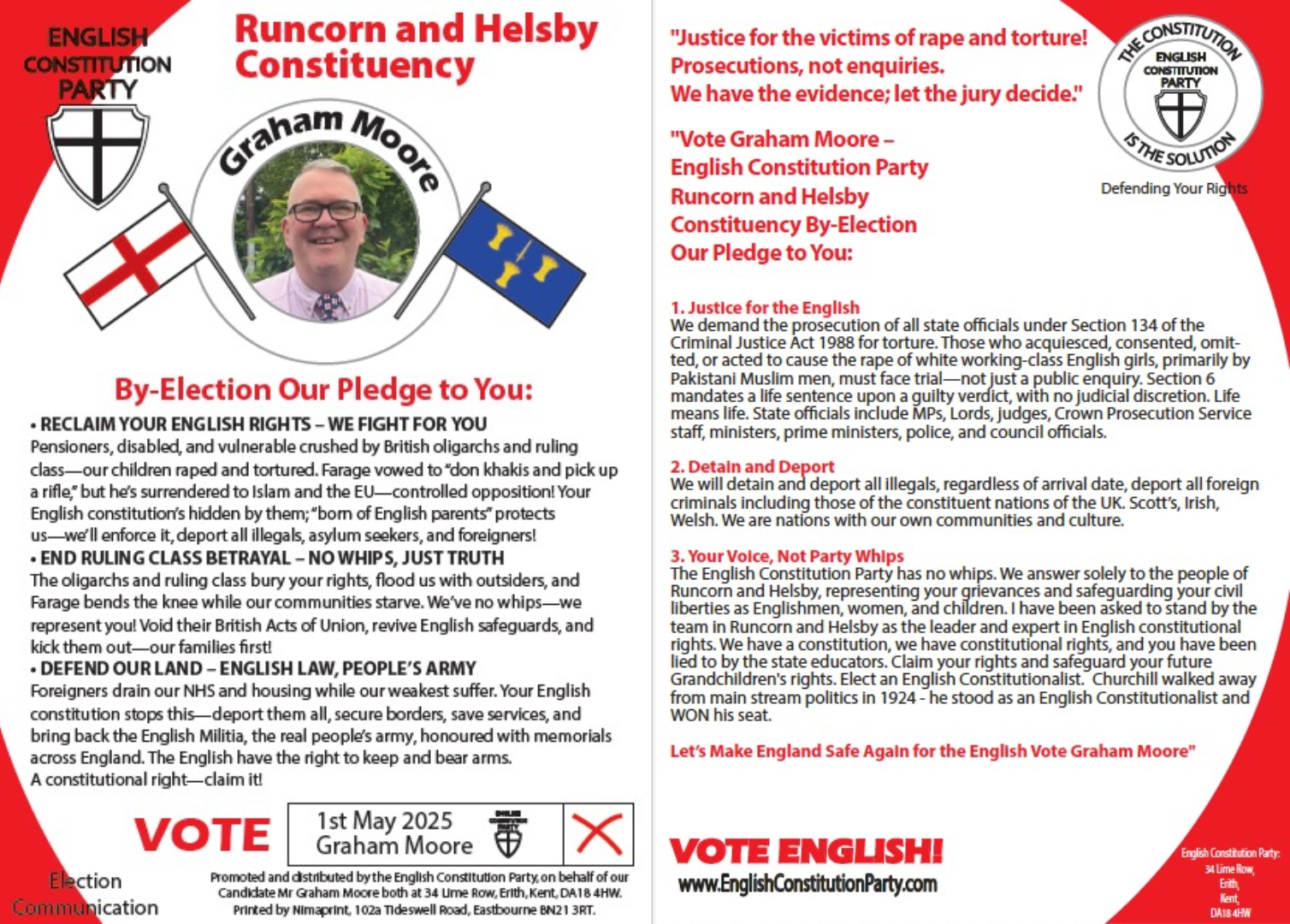


Justice for Victims – Runcorn & Helsby By-Election Challenge
Graham Moore | English Constitution Party (ECP) Campaign Overview
- Date: May 1, 2025 – Graham Moore stood as ECP candidate in the Runcorn and Helsby by-election.
- Core demand: Justice for victims of rape and torture.
- Key assertion: State officials enabled these crimes and should face prosecution under Section 134 of the Criminal Justice Act 1988 (torture). Criminal Justice Act 1988
- Evidence basis: Forthcoming National Audit on Group-Based Child Sexual Exploitation and Abuse by Baroness Louise Casey (published June 16, 2025). www.gov.uk/government/publications/national-audit-on-group-based-child-sexual-exploitation-and-abuse
- Supporting claim: Potential conspiracies under Section 1 of the Criminal Law Act 1977, backed by Dominic Cummings’ video alleging high-level cover-up. Officials wanted 'total cover-up' of grooming gangs scandal, claims Dominic Cummings
- Commissioned and produced at campaign expense.
- Approved by Royal Mail with delivery code.
- Intended free delivery to 45,400 addresses by April 23, 2025 (under Representation of the People Act 1983).
- Royal Mail failed to deliver it.
- Officials ignored reports and blamed victims.
- Audit confirms “significant failures” in Rochdale, Rotherham, and Telford.
- In Rotherham alone: 1,400 children suffered severe pain or suffering (1997–2013).
- Meets Section 134 torture threshold via omissions and acquiescence.
- Supports Section 1 conspiracy (senior officials ordered suppression of concerns).
- Officials hid or sanitised data to protect gangs.
- Audit verifies significant gaps and deliberate record-cleaning.
- Prolonged victims’ suffering → Section 134 liability.
- Coordinated concealment across regions → Section 1 conspiracy.
- Culture of denial; victims and whistle-blowers suppressed.
- Example: Oldham (2022 review).
- Systematic silencing = consent to infliction of severe pain or suffering (Section 134).
- Coordinated suppression = conspiracy to pervert justice (Section 1).
- Officials avoided investigations to dodge “sensitive” issues.
- Politics prioritised over child safety.
- Consistent inaction meets Section 134 criteria.
- Widespread omissions confirm conspiratorial agreement (Section 1).
- Legally obligated to deliver the approved leaflet for free.
- Failed to distribute to 45,400 addresses.
- Alleged deliberate act to prevent voters learning the truth verified by the Casey Audit.
- Overseen by Chief Executive Stephen Young (Acting Returning Officer).
- Alleged misrepresentation of ballots, including an “impossible” 50-vote tally identical to a 2016 result.
- Claimed motive: protect local officials implicated in CSEA failures.
- Failed to investigate non-delivery or ballot irregularities.
- Alleged harassment of ECP campaigners.
- Claimed motive: shield the force from revelations of systemic acquiescence.
- Petitioner: Graham Moore
- Date: October 2, 2025 – Hearing in Runcorn and Helsby
- Demand: Annul the May 1, 2025 by-election result.
- Grounds: Erroneous and/or deliberately fraudulent count, illegal non-delivery of leaflets, and police complicity.
- Impact: Undermined democracy and stole the £500 candidate deposit.
- Section 134 (Torture): Acts, omissions, acquiescence, and consent that enabled severe pain or suffering.
- Section 1 (Conspiracy): Agreements to obstruct justice and conceal crimes.
- Intent can be inferred from deliberate acts or omissions (supported by case law such as R v Zardad [2007]).
- Casey Audit evidence (suppressed reports, data gaps, silenced whistle-blowers) provides foundation for prosecution.
- Call for a national statutory inquiry as recommended by the Audit.
Election interference was a calculated attempt to silence that truth.
High Court hearing: October 2, 2025 – Runcorn and Helsby. Read the Audit: National Audit on Group-Based Child Sexual Exploitation and Abuse (published June 16, 2025).
Runcorn and Helsby parliamentary by-election takes place 1–2 May 2025.
15 candidates stand, including Graham Moore for the English Constitution Party.
Result declared: Sarah Pochin (Reform UK) elected by just 6 votes.
Graham Moore is recorded as receiving exactly 50 votes
ROYAL MAIL - election interference
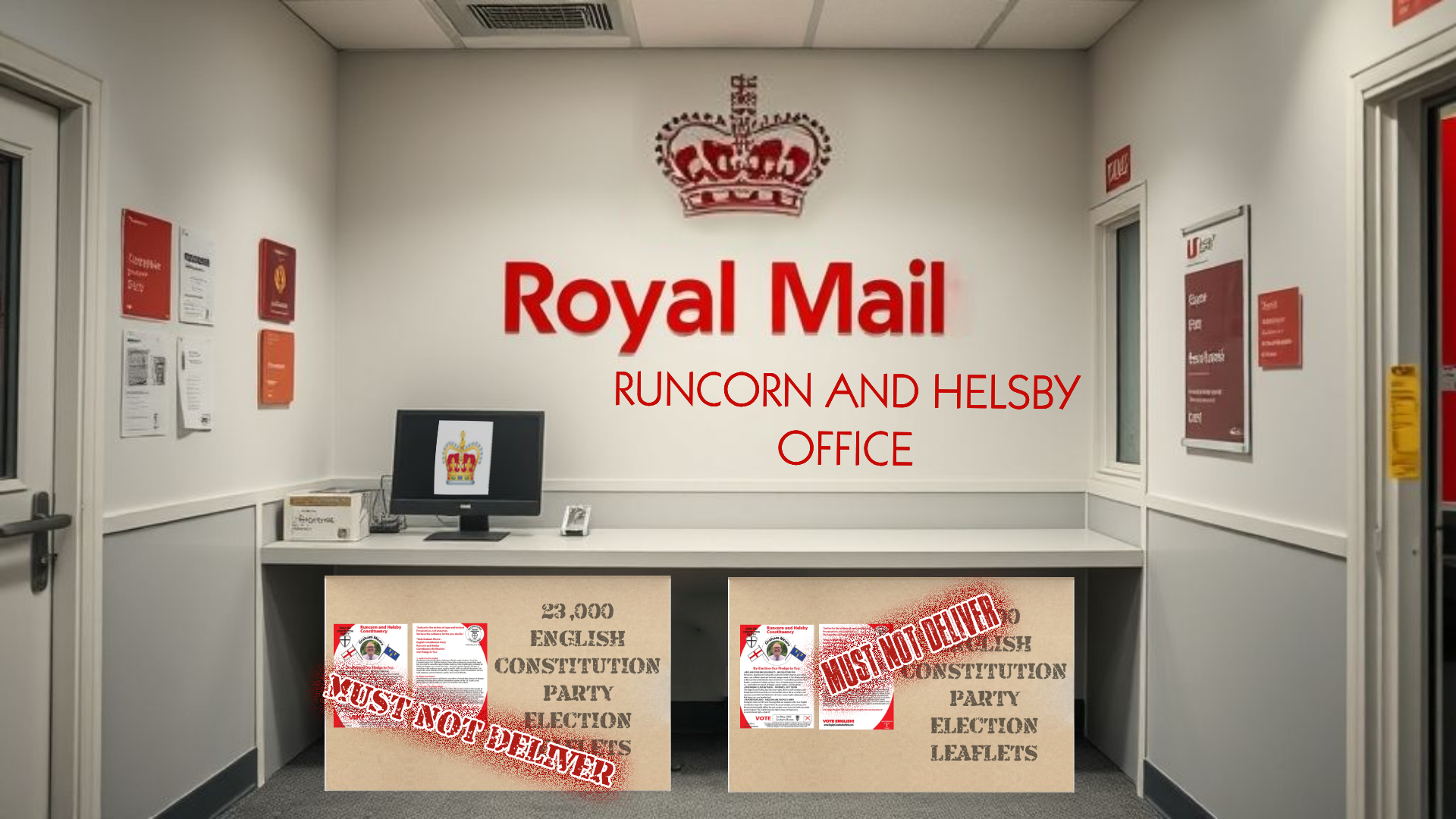

The English Constitution Party (ECP) prepared and had approved a free “election communication” leaflet (the statutory free postal mailing that every parliamentary candidate is entitled to send). It was approved for delivery to approximately 45,400 addresses in the constituency, with a target completion date of around 23 April 2025. Graham Moore claimed Royal Mail failed to deliver the leaflets (or delivered them only partially/incompletely), while leaflets from other candidates were delivered. He said this amounted to deliberate “election interference” that suppressed awareness of his campaign (which focused on issues including group-based child sexual exploitation (please see leaflet at the top of this web page), alleged state failures, and related legal points). He relied on statements from constituents who said they never received an ECP leaflet, plus emails/assurances from Royal Mail that delivery had been completed. In his public statements and petition he described this as knowing interference intended to shield the establishment. Graham also had been contacted by a whistle-blower employee of Royal Mail, who had seen the boxes of the ECP leaflets stored under a desk (undelivered) with a sign on saying 'MUST NOT DELIVER'.
Cheshire Constabulary – harassment and failure to investigate

Cheshire Constabulary harassed the ECP campaign in the run-up to the 1 May 2025 by-election. CLIP OF GRAHAM EXPLAINING THE HARASSMENT RECEIVED
The force failed to investigate “election interference,” specifically the removal of an English Constitution Party Wikipedia page during the election period.
These actions (or inactions) further undermined the fairness of the election and contributed to an unfair outcome.
CLICK HERE TO SEE COPY OF FORMAL LETTER OF COMPLAINT TO POST OFFICE AND CHESHIRE POLICE
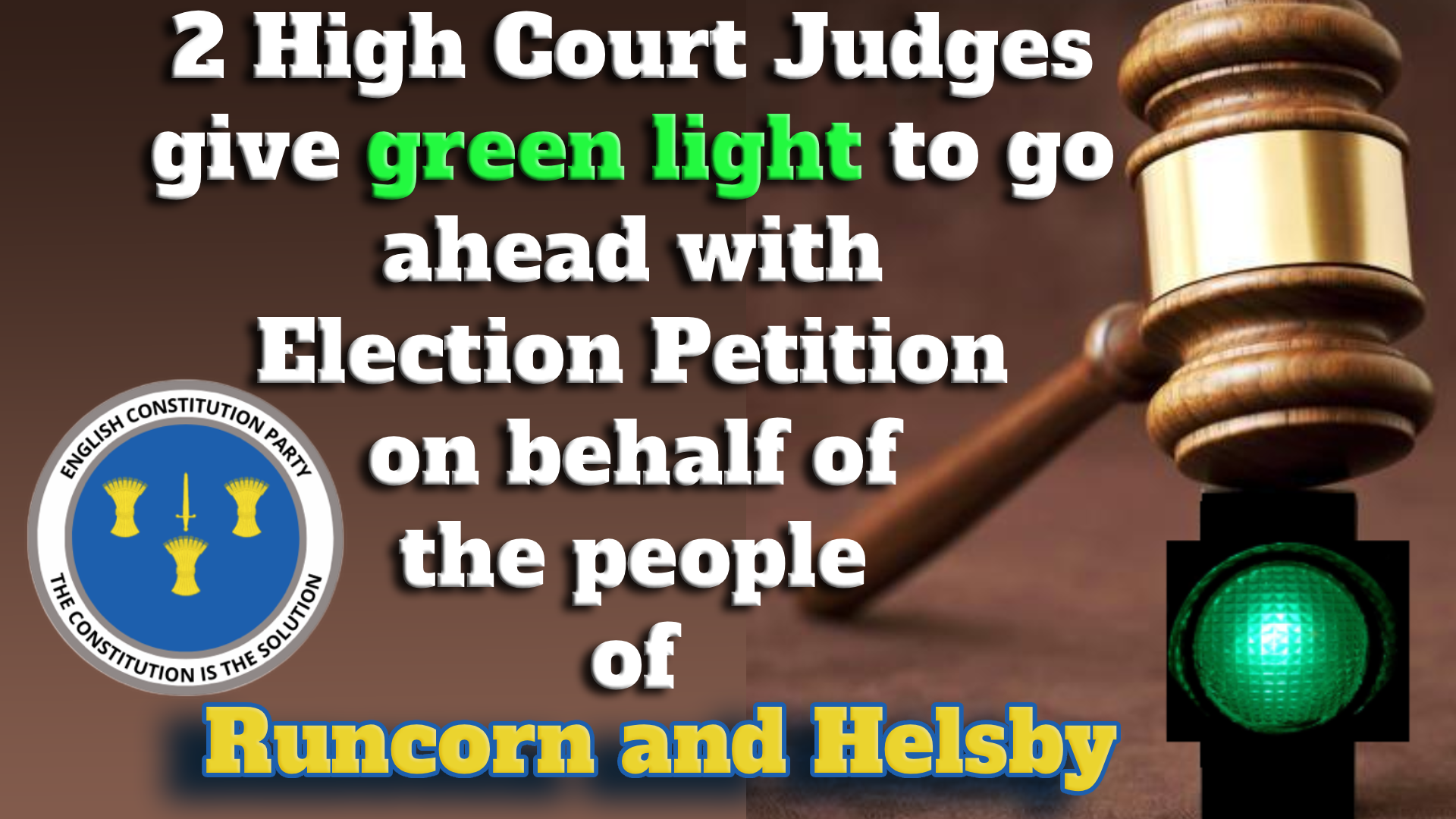
Crucially, it allowed the petition to proceed to a full trial against Pochin and the Returning Officer, despite procedural defects in the petition (missing information under the Election Petition Rules 1960 and service issues).
The judges emphasised Moore’s “fundamental right to contest the integrity of the election” and that procedural technicalities should not override substantive rights.
THE COUNT ITSELF
- The chance of Graham Moore receiving exactly 50 votes in the 2025 election (based on his expected range of support) was roughly 1 in 1,000.
- The chance of this happening in both the 2016 Tooting and 2025 Runcorn elections was therefore 1 in a million.
- He and his counting agents personally saw far more than 50 of his ballot papers — he estimated 116 (two bundles of 50 plus about 16 loose papers).
- Votes were being clipped into bundles of 50, which he said made it easy to manipulate the total to the “magic number” of 50.
- There was a chaotic “sleight of hand” scene at the central tables where votes were consolidated (as far away as possible from ALL counting agents).
- When a recount was called because of the extremely close Reform–Labour margin, it was not a full recount of every individual ballot paper. Instead, he alleged, staff only flicked through the corners of existing bundles to check the number of papers, without examining the votes themselves (video evidence to prove this).
- At trial, the Returning Officer admitted the count staff were imported from other constituencies — a hand‑picked team — while telling the court a “full recount” had taken place when it hadn’t (counting corners is not examining ballots to check they are in correct bundles). The two trial judges then accepted his word without verifying it, refusing to examine the ballots that would have exposed the truth. Imported staff, a false recount claim, and judicial refusal to check the evidence together create the stark appearance of a process engineered to avoid scrutiny. Isn’t that the point of a trial — to look at the evidence rather than take someone’s word for it?
STATISTICAL ANALYSIS via Royal Statistical Society

This is exactly the same amount of votes as the previous election Graham stood as a candidate in, which was the 16 June 2016 Tooting parliamentary by‑election, where he also stood as a candidate. Graham Moore called a statistician (from the Royal Statistical Society) named Nigel Jacklin to give evidence on the “statistical issue” in his election petition. Jacklin prepared a report and calculated (among other things) that the chance of Graham Moore getting exactly 50 votes in both the 2016 Tooting and 2025 Runcorn by-elections was extremely low — figures in the region of 1 in 1,000 for one election and therefore 1 in a million (or 1 in 10,000 under more generous assumptions) for both. He also estimated that Moore’s “true” vote share should have been higher (around 464) based on Graham Moore’s claim of having seen ~116 ballots for himself at the count.


CASE LAW ARCHIVE (ROYAL COURTS OF JUSTICE)
VIDEO CLIPS RE THE ELECTION PETITION COURT CASE
 |
 |
|
|
 |
 |
 |
 |
 |
 |
 |
 |
 |

CONSTITUTIONAL CONCLUSION
Under the Representation of the People Act 1983 (another unconstitutional act created by the State), the court struck out every actor except the Returning Officer and the winning candidate — including the police and Royal Mail — even though both played direct roles in making a free and fair election impossible.
Royal Mail’s failure to deliver the election leaflet deprived voters of essential information, and police interference — including refusing to investigate the Wikipedia deletion and pressuring the ECP over action days — materially affected the fairness of the campaign. Yet the RPA 1983 makes these actors legally untouchable inside a petition, so their conduct was excluded automatically.
And in Chester Crown Court at Colvin House, what was formally described as a “trial” was, in substance, nothing of the sort. A trial requires examination of ALL evidence, yet the primary evidence — the ballots — was never inspected. Instead of testing the Returning Officer’s assertions against the ballots themselves, the judges accepted unverified testimony. A proceeding that relies on hearsay while refusing to examine the underlying evidence is not a trial; it is a procedural hearing presented as one. Without looking at the ballots, the factual basis for determining lawfulness was never established, and the core question remained untried.

It is constitutionally equivalent to a murder trial in which the court refuses to conduct a post‑mortem, yet still proceeds to reach a verdict. When a court declines to do a forensic audit of the primary evidence (the ballots), any conclusion it reaches is inherently unsound. A determination made without examining the primary evidence is not justice — it is a non‑trial masquerading as a trial.

The Representation of the People Act 1983 reflects Fabian administrative philosophy because the British state machinery that produced it had already been shaped for decades by Fabian ideas: centralisation, bureaucracy, technocratic control, and procedural gatekeeping.
Fabianism assumes: Experts should run the system; ordinary people should not interfere.
RPA 1983:
-
requires specialist legal knowledge
-
makes petitions impossible for laypeople
-
empowers Returning Officers and civil servants
-
disempowers independent candidates and ordinary subjects
This is a direct reflection of Fabian technocracy.

THE BOTTOM LINE
The Representation of the People Act 1983 (created by the State) prevented the court from examining the conduct of the police and Royal Mail, even though their actions directly undermined the possibility of a free and fair election. Royal Mail’s failure to deliver the election leaflet and the police’s interference — including refusing to investigate election‑related misconduct — were struck out automatically because the statute has been designed to exclude external (State controlled) entities from scrutiny/justice. The judiciary that are aware of that statute loophole have done nothing in regards to correcting this unconstitutional unlawful situation. After Graham won the appeal, the case proceeded to what should have been the full trial, but the trial judges refused to examine the ballots or any evidence before deciding whether the election count was lawful or unlawful. Also the final trial judges took it upon themselves to quote that the Royal Mail has no legal requirement to deliver post. Royal Mail has been repeatedly fined — £5.6m (2023), £10.5m (2024), £21m (2025) — for failing to deliver mail on time, and each fine was issued because Royal Mail breached its legal Universal Service Obligation (USO) to deliver letters nationwide at set standards. Postal Services Act 2011, plus the Universal Postal Service Order (2012, amended 2013 & 2025) and the DUSP Conditions imposed by Ofcom. These documents legally bind Royal Mail to deliver letters six days a week (until the 2025 reform), at uniform prices, and to meet strict delivery targets.
The actors who made a fair election impossible were legally shielded by the State, and the evidence that could prove the election unlawful was never looked at.
The English constitution protects free and fair elections through the Bill of Rights 1689 (“elections ought to be free”), the common‑law rights of political participation, and the constitutional conventions that guarantee political communication and petitioning. Together, these form the constitutional requirement that elections must be free from interference and conducted under conditions that allow voters to make an informed and independent choice.
Under the ancient English constitutional tradition — before 1707, before party politics, before modern bureaucracy — elections were:
-
open to every free English subject
-
challengeable by any subject
-
accessible without wealth
-
governed by common‑law fairness
-
not dependent on specialist legal knowledge
This comes from:
-
the common law right of petitioning the Crown
-
the right of free Englishmen to challenge unlawful governance
-
the principle that elections must be “free and open”
-
the idea that Parliament is answerable to the people, not lawyers
Independents and ordinary citizens are effectively excluded, not only by complexity, cost, and strictness, but by the looming threat of personal bankruptcy — a weaponised cost‑regime capable of destroying litigants even when they win, as Graham’s case now demonstrates.
And to question the outcome of a proceeding that never examined the evidence — the ballots — would require an application to the Supreme Court costing £5,000 simply to open the case. This financial barrier means that an ordinary citizen or independent candidate cannot realistically challenge a non‑trial masquerading as a trial. When the factual record has not been examined, and access to review is priced beyond reach, justice becomes structurally inaccessible.

Lets now look at the differences between ELECTED AND SELECTED ie constitutional elections and communist style elections. This is proof the judiciary is captured and controlled by the 'British' State, suppressing the English laws and rights of free and fair elections, and putting in place Acts and Statutes that immediately takes away free and open aspect of elections, which goes against our English constitution.


Under English common law, elections are governed by original jurisdiction — the ancient rights, customs, and duties that pre‑date statutory intervention. Statutory law does not control elections; it can only administer what the common law already provides. A crucial feature of common‑law originalism is that it does not recognise desuetude: rights and jurisdictions do not fade away through disuse. They remain active, binding, and enforceable unless lawfully repealed. In this sense, common law is originalist law — continuous, persistent, and not subject to erosion by administrative or Roman‑style legal doctrines.
